|

 BILL
ADAMS BILL
ADAMS  TUMBLEWEED
SADDLERY
I am a retired firefighter
and a retired cattle rancher. I also do some cowboying part time. I have
done leather work all my life and have been making saddles for five years.
I work out of my shop at home and make five or six saddles a year as well
as any kind of cowboy horse gear, namely chinks, breast collars, bridles,
hobbles, bucking rolls, and fence pliers cases. I sell Moore Maker fence
pliers, saddle blankets, bits and spurs. TUMBLEWEED
SADDLERY
I am a retired firefighter
and a retired cattle rancher. I also do some cowboying part time. I have
done leather work all my life and have been making saddles for five years.
I work out of my shop at home and make five or six saddles a year as well
as any kind of cowboy horse gear, namely chinks, breast collars, bridles,
hobbles, bucking rolls, and fence pliers cases. I sell Moore Maker fence
pliers, saddle blankets, bits and spurs.
LAILA ASGARI Warmed
glass artist - Kiln fired glass
Laila Asgari, a local artist raised in southern California, took an
interest in the western lifestyle at an early age, learning how to ride at
the age of five years. As a youngster, Laila coupled her interest in art
with her love for horses, experimenting with oil, pencil, and charcoal. As
an adult she discovered glass as an art medium, and using the glass fusing
technique and crushed glass, she has been able to transfer her passion for
the West into functional art, creating pictures with glass. Each glass
piece is handmade and kiln-fired creating unique one-of-a-kind pieces. Her
collection includes wall hangings, wall tiles, plates, picture frames, and
coasters. Many of the pieces are created from personal experiences, which
led Laila to market her fused glass art under “Serendipity Blue -
designs in glass”.
Samples here:  and here:
RON
BUTLER
BUTLER'S SADDLE SHOP
For
over 25 years Ron Butler has made beautiful, top-quality, custom-made
saddles and leather goods for the many of California’s working cowboys.
Today, with the help of his wife, Cheryl, and daughter, Sarah, they
continue to work hard outfitting all working cowboys and cowboys-at-heart
with the same outstanding quality tack people have come to expect from the
Butler family!
GINNI
CARY I
create western hatboxes, completely handmade and cut in my ranch workshop
in the same building my great-grandfather once had a blacksmith shop.
My boxes feature western borders, wallpaper, and genuine leather
with adornments in variety of size and shapes.
DON
AND DORINE CASWELL -- CASWELL TRADING CO.
Western
memorabilia.
We
will have on display and for sale to the public a large collection of
antique cowboy and Indian collectibles from the late 1800’s and early
1900’s.
We specialize in old fancy chaps, California spurs and bits,
braided rawhide bridles, and California gambling items such as silver and
ivory daggers.
Other items will include Winchesters, Colts, Native American
beadwork and jewelry, cowboy and cowgirl decorator pieces, and much more.
CHORRO
VALLEY REGULATORS
Members of the Single
Action Shooters Society.
You can see their local club listing here: 
DOUG COX
Saddle Maker
Gardnerville, NV.
 RUTH DEOUDES
Pencil drawings and prints
The execution and technique
of her pencil drawings are very important to her, but her main goal is to
create a vision the viewer can relate to. With humor and sensitivity, Ruth
invites you to share a moment in the life of the rural
American.
RUTH DEOUDES
Pencil drawings and prints
The execution and technique
of her pencil drawings are very important to her, but her main goal is to
create a vision the viewer can relate to. With humor and sensitivity, Ruth
invites you to share a moment in the life of the rural
American. 
PASO
GATHERING DRAWING SPACE, PIONEER MUSEUM
GRIFF DURHAM
Author, Historian
ED
FIELD
Bits and more - silverwork
Ed is a well known, 4th
generation bit maker who lives in Paradise, near Lake Cachuma in Santa
Barbara County. His work is widely sought by collectors. Ed learned the
craft from his grandfather, John J. Field, whose bits are very rare and
collectible. John J. learned from his father, Ed's great grandfather, who
learned his skill at Tiffany's while making silverware, knives and spoons.
His great grandfather came out west with Fremont, then returned to
Connecticut, packed up his tools and gear and returned to Calaveras, then
to Santa Barbara.
Around 1890,
you didn't buy a bit from a store. You went to a blacksmith and had one
made. They were all different: different sizes and different thickness of
steel. Even the cheek plates didn't match. Very few had any inlaid
silverwork.
Ed's dad
made spurs, inlaid with silver. After WWII he sold all he could make to
Jedica Saddlery in Santa Barbara. Ed's aunt, Rita Thornburg, made bits and
put two sons through college.
Ed learned
his trade while a grammar and high school student. He also worked on
ranches and for the Forest Service. Town didn't agree with him, so he
moved back to where he got his start.
Ed says he
is 85 and still working and "I'm not going to quit. It gets me out of
the house and keeps my brain working." His wife says Ed enjoys work,
but not when it comes to yardwork. He is happiest when he completes a
project.
Ed's son
Gary Wayne Field has been working with him for 7 years and is doing a
"good job" according to Ed. Both will be at the Paso Gathering,
where Ed is a generous sponsor of the event. He donates a handcrafted
silver inlaid bit each year for the fund raising drawing.
BRUCE HAENER
Bit & spur collector and
maker
HEATHER
HAFLEIGH
HEATHER HAFLEIGH PHOTOGRAPHY
Heather
has devoted more than 18 years to documenting contemporary ranchers,
horsemen, and craftsmen in California carrying on the vaquero tradition.
Her work is widely exhibited and is in the
collections of the Autry Museum of Western Heritage, the Oakland Museum of
California, and the Western Folklife Center in Elko, Nevada.
 JOE and MARICELA HERNANDEZ
Silver bits and spurs
King
City, CA.
JOE and MARICELA HERNANDEZ
Silver bits and spurs
King
City, CA.
ZENON
HIPOLITO ZAPOTEC
INDIAN ART
Handwoven
Zapotec
rugs and pillows
Zenon
Hipolito is a master Zapotec weaver.
Weaving is an Indian tradition that has been passed down from
generation-to-generation. Weaving
expresses the determination of a courageous
person that is very committed to their artistry and their own tradition.
Zapotec natives originated in Oaxaca of Teotitalan Del Valle. Amongst the natives, about 400,000 Zapotecs had lived in
valleys and on huge mountains, and later migrated across
southern Mexico. The Zapotecs
are one of the countries largest indigenous groups dating
as far back as the sixteenth century.
Zenon Hipolito was born in Oaxaca, Mexico on May 7, 1956.
Taught by his father at the
age of eight years old, Zenon utilized circular designs.
These designs are amongst the most
difficult and require careful use of the loom.
Zenon uses the best quality wool and vegetal dyes in each piece of
art. Most of the designs come
from the ancient Zapotec temples.
It has been difficult to keep the tradition of Zapotec weaving alive in
the states. In an attempt to
teach the art of the loom and strengthen the tradition, Zenon plans to
give classes that will teach people the process of the wool and the dyes.
Successfully, this tradition
has been kept within the family, demonstrated through stories and the
construction of his own loom. Zenon has made it a point to teach his family of their native
roots.
CHARLES IRWIN
Bits, spurs, rawhide
BRIAN
KUNIC -- TULLY HOLE SADDLERY
Custom horse gear
I
specialize in making custom horse gear for today’s working cowboy,
including chaps, spur straps, headstraps, etc.
DEBORAH
KUNIC
Painting and printmaking
AMANDA LEWIS
Custom cowboy gear - leather
Oreana, ID.
e-mail:l
lewama@aol.com
BETTY MILLER
Western jewelry and
paintings
VEL
MILLER
Oil painting and
sculpture
Vel
Miller’s house/studio is a chest of treasures that sits atop one of
those rolling Central California hills that meander down to the Pacific
some 20 miles away. The
house, like the artist, is filled with memories of the most important
things in life…people…mementos of family, friends and mentors who have
enriched her life. Paintings
cover the walls and sculptures sit atop antique tables draped with
cowhide. Your eye can’t
travel an inch but it encounters some richly patinaed artifact of the Old
West…the things of which Vel’s life is made!
In
painting and sculpting, Vel concentrates on the more emotional view of the
West. Vel says, “The most
rugged and strongest people I’ve known have also been the kindest and
most loving. This is the
feeling I try to portray. I
want the person who views my work to see something they have experienced
themselves, or to feel a mood that brings them happiness.”
Vel wrote: “The West lives on, not just in the heart of the cowboy
roping a calf or an Indian chasing a buffalo.
It lives in all of us. It’s
the hardships and the rewards. I
see it in a child with his or her animals or a mother or father with their
children. It’s the wonder
of the latest crop of calves or colts, or just the evening light shining
across a meadow. I hear it in
the creak of a new saddle and the nicker of a mare to her foal or perhaps
the crow of a rooster announcing a new and sparkling day.
It is
true that some of the images are gone and some live only in the artwork
created before us, but there is still a story to tell and world full of
subjects to portray. This is what all Artists, whether craftsmen, painters,
sculptor, singers or storytellers, are trying to present: the love we feel
for the West. We hope you
share it with us. If you do,
the West and the Spirit of the West will live forever.”
Vel
attended the Art League of Los Angeles, studying under Hal Reed and Max
Turner. She later taught
there. An important mentor,
Joe Deyong, a protégé of Charlie Russell, encouraged and inspired her
with his stories and love of the Old West.
Participating
in numerous exhibitions, Vel has earned over 40 “Firsts,” Best of
Show,” and “Purchase Awards.” She has completed several corporate commissions.
Her work is displayed in museums and public and private collections
Internationally. She and her
artwork have been featured in Contemporary Western
Artists, several
editions of Southwest
Art and Art of the West
magazines. She is currently
listed in “Who’s Who in American Art,” “Who’s Who in the
West,” “Who’s Who of American Women,” and “An Encyclopedia of
Women Artists of the American West.”
Vel was commissioned to do the drawings on Western
Horseman’s
Cowboy Calendars for 1997, 1998, 1999, and 2000 and has recently
illustrated and created covers for several books. Vel was in a show in Sorrento, Italy in September 2000 with
The American Women Artists, an artist group of which she is a founding
member. The Mayor of Sorrento
purchased one of her paintings. In
the fall of 2000, Vel was commissioned to do a heroic size monument of the
City of Paso Robles, California. The
8-foot high sculpture of a Fireman handing a baby to a Policewoman, titled
“Reward for Valor” will be dedicated in 2004.
Vel
and her husband, Warren, currently own a Central Coast ranch where they
raise Texas Longhorn Cattle and American Quarter Horses.
DON
MOE
Saddle Maker
Paso
Robles, CA.
 SPARKY
MOORE
Artist and Illustrator SPARKY
MOORE
Artist and Illustrator
Richard
“Sparky” Moore does a variety of artwork with western flare.
His background as a cartoonist for more than 50 years for
studios like Disney, Hanna & Barbera, and Dell/Western Publishing
had him drawing anywhere from adventure to western comic books like
“Little Beaver” and “Range Rider” to many years of drawing,
among others for Disney studios, “Winnie the Pooh” for both books
and newspaper comic strips.
He now uses that creative imagination to give us western art
that offers, at times, humor as well as taking us back to a way of
life that used to be.
Come by and see what “Sparky” has come up with this year,
you’ll find anything from hand carved rocking “mules”, cowboy
and cowgirl cutouts, and of course his popular western sketches.
ERNEST
MORRIS
Ernest Morris was born
December 13, 1927, a fifth generation California cattleman. His youth was
molded by ranch life in the central coast area of California where he
worked with older men who followed the California vaquero horsemanship
style. Ernie especially credits his grandfather, Jesse Wilkinson, with
teaching him many of the vaquero ways, and the techniques for making
quality rawhide equipment.
Ernie's art
talents began to show at an early age, with special interests in the
California vaquero. Vaquero art was a hobby for Ernie until 1964 when he
became a full-time artist as an occupation. In 1967 Ernie began placing a
small hackamore beside his name on his paintings as a symbol to connect
his art and his rawhide work.
He has
created artwork with pen and ink, pencil, charcoal, watercolor, oils,
acrylic, bronze sculpting, and wood carving, and he has authored and illustrated
four popular books about vaquero horsemanship and livestock handling ---
El
Vaquero
(published in 1989), El
Buckaroo (published
in 1995), and Riata
Men
(published in 1999) and
California Cowboy
Inventions.
His art, rawhide work,
and books have been featured in galleries, museums, and private
collections throughout the United States and in many other parts of the
world.
Although
Ernie's art encompasses most of his time, he is active in the cattle
business, training his won ranch horses, braiding rawhide gear, and
occasionally making horse-hair mecates. Ernie and his wife, Blanche,
reside on their ranch near Templeton, California, where they enjoy Western
art, horses, cattle, and friendly conversation.
JOE ORTIZ
Tack, braiding, cowboy items
Tecate, CA.
DIANNE
PARTINGTON Original
Western/Native American Silver/Turquoise
Jewelry Dianne
Partington, has collected vintage western and pawn jewelry for over 40
years and because of that has acquired a keen eye for quality workmanship.
Silver Horse Designs, was born out of that passion.
Many of her pieces have a Native American influence while others
have a classic western style.
Working out of her
tack room, Dianne creates one of a kind designs that include new pieces as
well as redesigned pawn. Some
of the turquoise she finds originates from mines that have long been
closed, making her pieces more rare.
She also uses top quality coral, pearls & semi-precious stones
for added color and unique character, and only the finest sterling silver.
Her designs have been
featured in national magazines, and have been worn, most recently, by
American Idol winner and country super star, Carrie Underwood in a photo
shoot for Country Weekly.
Since she was old
enough to walk, Dianne has connected with horses and the classic
California ranch lifestyle. A dedicated animal lover, she always dreamed
of a life surrounded by horses, cattle, dogs and cats.
She made that dream a reality while living on the Cojo Ranch in
California, then later by moving to the Central Coast after meeting her
husband Dan 15 years ago. It
is here that she has firmly planted her roots in the horse country of Paso
Robles where she’s bred and raised countless good horses.
Her passion for this lifestyle and Native American artistry
inspired her to become a designer. You’ll often see her heading to town in her truck and
always with her beloved dog Rowdy, hauling her horses or jewelry to events
and trade shows, sharing a smile and a horse story with everyone she
meets.
Anyone who knows
Dianne will tell you that her greatest pride in life will always be her
family – her husband Dan and three daughters, Angela, Alison and Aimee.
LARRY
PECK Western
memorabilia
MICHAEL
RHOADS
Silver
- new and collectible, bits, spurs, bridles,
saddles and fine Palm hats
DICK
& JOANNE ROLL
J.D. ENTERPRISES
Cowboy antiques - custom hats
San
Marcos, CA.
TERRI
ROSE
Oil paintings on canvas
Paso
Robles, CA.
|
 |
Painter
of horses since childhood and later was able to own my horse.
Grew to love trail riding then started competing in long-distance
endurance riding. Great
satisfaction is felt when combining art with hands-on life with riding
horses. I also paint
landscapes with horses, westerns, and pet portraits. You can e-mail
at: jdrose@tcsn.net |
DON
SHORTS
Historical and collectible
books
Don
Shorts is the co-owner of Ventura’s Old California Store and is an
author of books about Jo Mora and Mexican arts.
He also owns the Old California Press, which publishes books about
California and Mexico.
JOELLE
SMITH Artist, Painter and
Sculptor
We will
miss seeing Joelle at our event. Her loss is deeply felt.
GLENN
STEIN
Silverwork, Western
memorabilia
I
have been in California for about 44 years, and have been collecting bits
and spurs for 35 years. I
have been making bits and spurs for about 8 years.
TAPADERO - SUSAN JENSEN J & S
PRODUCTIONS
PHIL
TOGNAZZINI
Etchings and watercolors
GIL & JESSIE VELASQUEZ
Cowboy and Indian leather
and beads
Goleta, CA.
BUB WARREN Western
original art and reproductions
Paso
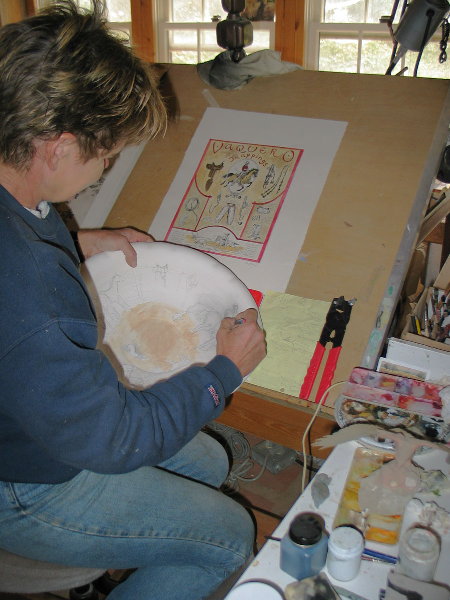
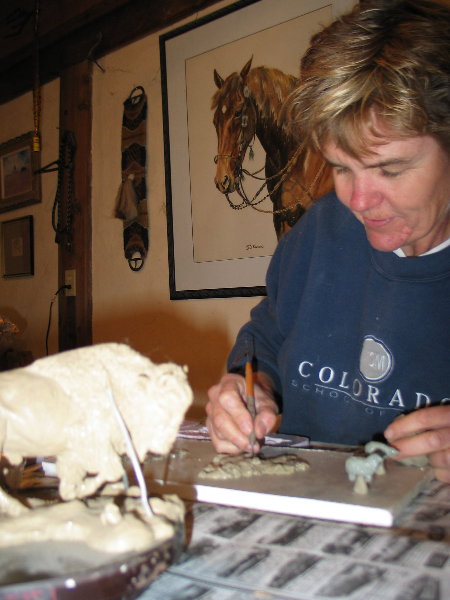
Robles, CA.
KAREN
FOSTER-WELLS Western
original art and reproductions, tiles and
cards
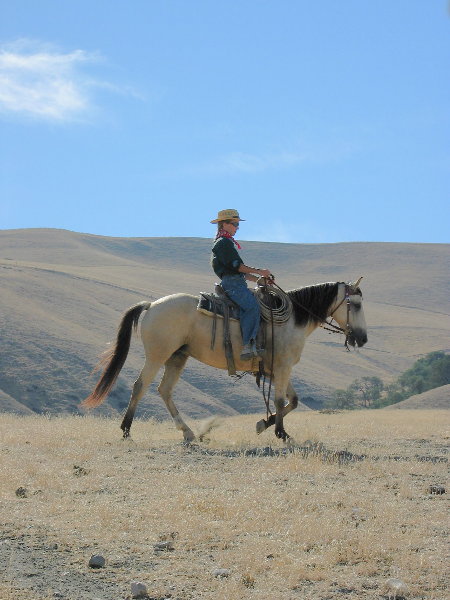
My
uncle taught me to herd cattle on a ranch in Arroyo Grande when I was
about twelve. I am still
helping with the cattle these days on the same ranch.
I got
my first horse when I was fourteen. We
rode bareback along the beach, and the horses ran as a herd along the
bluffs when we weren’t riding them.
My mother was painting all along the coast in those days, and I
would watch her set up her easel and paint in oils or draw with pen and
ink, the wild waves and rocky cliffs.
All of
this still inspires me. The horses and painting outside eventually have become my
twin passions. I still love
to help my friends and family work their cattle.
I still love to ride near the ocean, and on the wonderful ranches
of the Central Coast.
I hope
to be able to portray in pictures some of the powerful feelings I have for
these places. The people,
cattle, horses and old-fashioned ways of doing things, along with the
historic buildings and lands so potent with memories.
The ECR
Gallery in Cambria represents my art as well as California Classics in
Templeton. I exhibit at the
Cattlemen’s Western Art Show in Paso Robles and the Paso Gathering
at the Pioneer Museum in Paso Robles.
BACK
TO TOP
|